Should I still build a Shopify App in 2026? What 21,000 catalog slugs say
I crawled the entire Shopify App Store with a tool I built. Only ~768 apps are verifiably alive — but the empty shelves point to clear opportunities.
I’ve been building a Shopify App for ten years. GemPages — the page builder I run with my team — sits in the noisy top of one category in the App Store. From inside that game it’s easy to assume the catalog is enormous and saturated everywhere. It’s also easy, from inside, to be wrong about which slices are actually crowded and which are quietly empty.
So I wrote a small scraper. I call it partner-radar — a tool I built to crawl, score, and watch Shopify apps every day. It enumerated 20,965 unique app slugs across every category listing page Shopify exposes. It then went back and “enriched” a portion of them by fetching the detail page directly — reading the rating, the cheapest paid plan, the categories, the developer country, the review count. I keep enriching the rest in batches every week.
What follows is what the data actually says. It is unflattering in places. If you are a founder thinking should I build a Shopify App in 2026, this is the map. If you are a Shopify merchant trying to pick apps that will still be alive next year, the same map is your warning sign.
I’ll be blunt about both sides.
A catalog that looks like a city — but only one neighbourhood has people in it
The headline number is 20,965 apps. Round it to 21,000. That sounds like a city of competitors. The reality is closer to a city where one busy neighbourhood handles all the traffic and the rest of the streets are office buildings with the lights still on but nobody at the desks.
When I first wrote about this, I’d only enriched a top-priority slice — apps ranked highest by review count — so the data was biased toward “winners.” To get an honest read on the long tail, I added a second script that randomly samples unverified slugs and fetches each detail page. After 240 such random samples, the picture is dramatically different from “everything below the top is dead.”
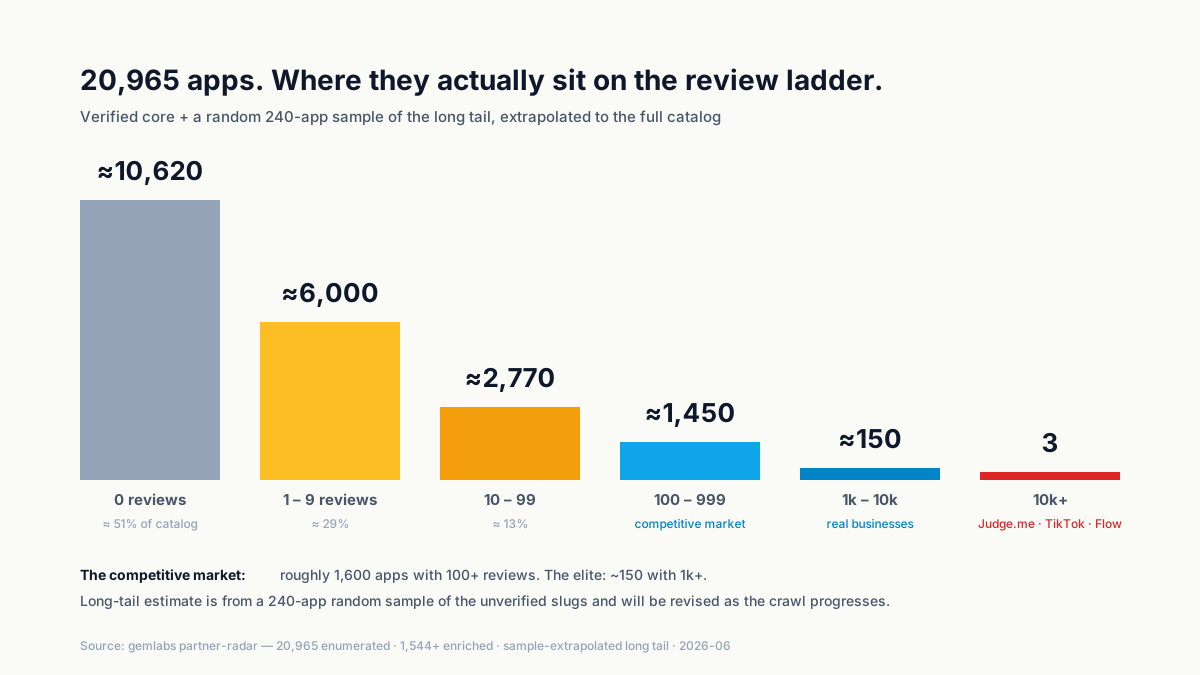
Here is what the long tail actually looks like, drawn from that random sample and extrapolated to the 19,661 unverified slugs:
| Review bucket | Estimated apps in the full catalog | Share |
|---|---|---|
| 0 reviews | ≈ 10,620 | 51% |
| 1 – 9 reviews | ≈ 6,000 | 29% |
| 10 – 99 reviews | ≈ 2,770 | 13% |
| 100 – 999 reviews | ≈ 1,450 | 7% |
| 1,000 – 9,999 reviews | ≈ 150 | 0.7% |
| 10,000 + | 3 | 0.014% |
Three honest sentences fall out of this.
First, about half the catalog (~10,600 apps) is truly cold — slugs that load fine but have zero reviews. That is the verified zombie share once we sample fairly, not the apocalyptic “96%” you’d get if you assumed every unenriched slug is dead.
Second, another ~9,000 apps are alive but tiny — they have between one and ninety-nine reviews. They exist, they have at least one merchant using them, but they are not yet a business. Many will never get there.
Third, the competitive market is roughly 1,600 apps — the ones with 100+ reviews. Above 1,000 reviews there are only about 150 apps in the entire store. Above 10,000 there are exactly three.
For comparison, those three at the top are Judge.me (39,956), TikTok’s official channel (13,191) and Shopify Flow (10,645). Two of the three are platforms (TikTok, Shopify itself). One independent developer — Judge.me — built the only third-party app to cross 10k. Below them: roughly 67 “real businesses” between 1k and 10k reviews — PageFly, GemPages, Globo, Avada, 17TRACK, Simprosys, Stamped, Notify!, Omnisend, Printify, Printful. Names a Shopify operator would recognise. Below them, things thin out fast.
This matters two ways. As a merchant, you walk through the App Store with the lights on but more than half the storefronts are empty. As a builder, you are not competing with 21,000 other apps. You are competing with ~1,600 serious competitors and ~150 incumbents. That is a smaller, sharper game than the headline number implies.
💡 How a seller should actually read this catalog
The list of apps with 1,000+ reviews isn’t a leaderboard — it’s a map of what tens of thousands of Shopify merchants have voted, with monthly subscriptions, is worth paying for. Read it backwards to extract decisions.
- Crowded categories reveal real pain. Reviews, page builders, popups, SEO, order tracking, subscriptions, COD upsell — these aren’t fashions. They’re problems the native platform couldn’t solve. The fact that the top of each category has multiple competitors with 1k+ reviews tells you the underlying need is real and your store probably has it too.
- The apps your competitors install hint at their funnel. A store running Klaviyo + Vitals + Judge.me + Recharge + Shogun is broadcasting its growth strategy: email retention + conversion bundling + social proof + subscription LTV + custom landing pages. You can copy the stack or counter it, but you should know it before you decide your own.
- Stack overlap signals working patterns. When the same app pair (Recharge + Klaviyo, AfterShip + Judge.me, Globo + GemPages) co-occurs across many stores, that pair is a tested workflow. A new tool that doesn’t fit a known pattern carries higher adoption risk — be skeptical of “everything-in-one” promises that ignore how stores actually run.
- Sparse categories with high-rated apps mean under-served needs. Customer support, inventory, B2B wholesale. If your business runs on one of these, you are probably paying an outside-the-App-Store SaaS vendor today for something no in-store app fully delivers. That contract is a budget line worth renegotiating annually — or replacing as new entrants land.
The seller habit: scan the top of each category in your stack at least once a quarter. The leaderboard moves slowly, but the integrations and the pricing tiers shift with the market — and that shift is where your stack-cost optimisation lives.
Where the reviews — and the money — actually live
Reviews aren’t revenue, but they are the closest free signal of usage. We summed reviews across the whole catalog and looked at how concentrated they are.
- Top 10 apps capture 33.1% of all reviews.
- Top 100 apps capture 80.9%.
- Top 500 apps capture 99.7%.
- The remaining 20,465 apps share 0.3% of all reviews.
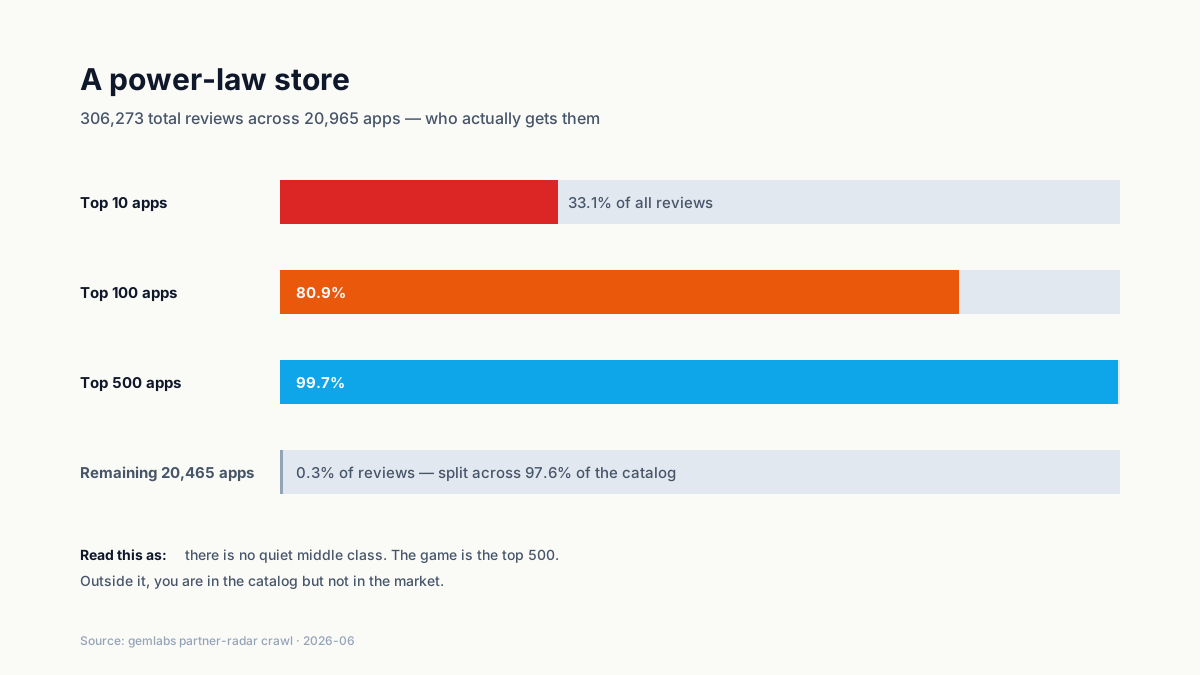
If you imagine the App Store as a marketplace, this is a power law of the most aggressive kind. It is not 80/20. It is 99.7/2.4. Five hundred apps eat almost everything. The other twenty thousand share crumbs.
Two implications fall out of this.
For builders: competing for the top 500 is the whole game. Outside it, you are technically in the catalog and practically not in the market. There is no quiet middle class.
For merchants: the top 500 is also more than you’ll ever need. Almost every category has a tested, well-reviewed leader. You don’t need to take chances on app #2,847.
The category map: where the gravity is
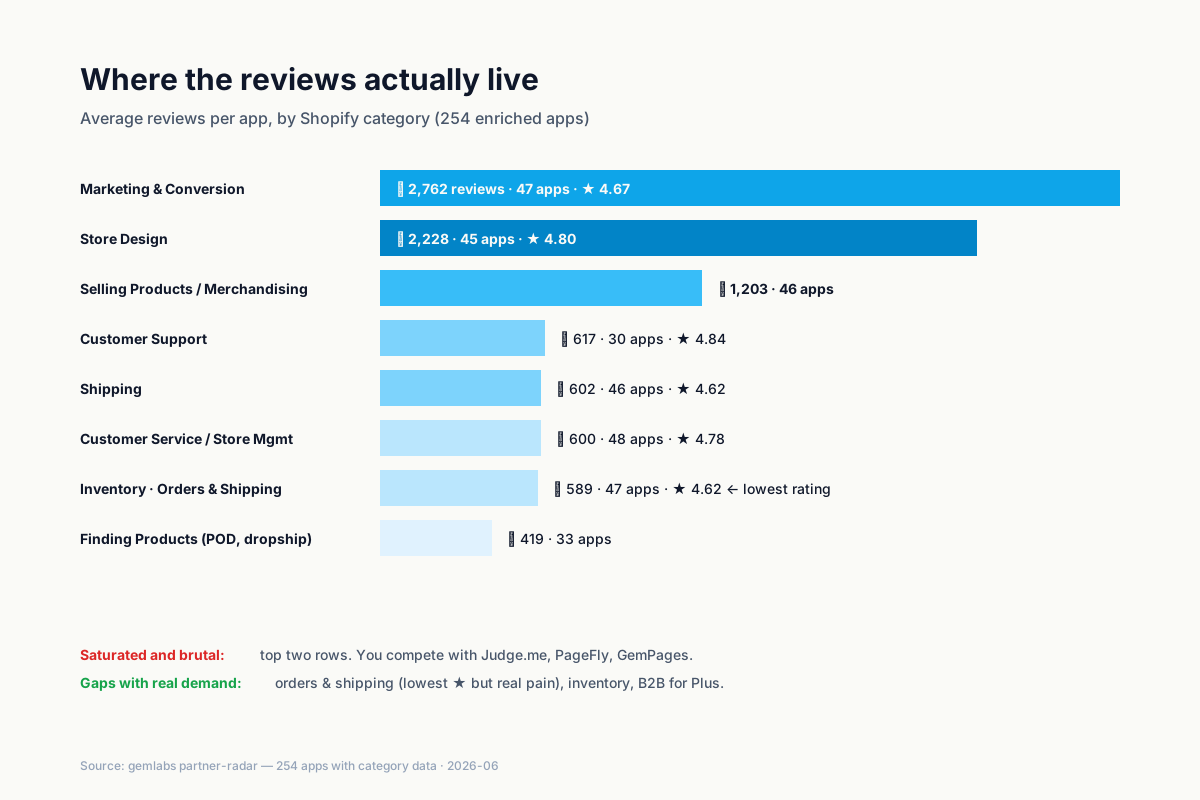
Each app in the catalog can be tagged with one or more Shopify categories — Marketing & Conversion, Store Design, Selling Products, and so on. Of the apps that have category data filled in (254 of the most enriched, top-of-funnel apps), here’s the picture by average reviews per app:
| Category | Apps | ⌀ Reviews / app | ⌀ Rating |
|---|---|---|---|
| Marketing & Conversion | 47 | 2,762 | 4.67 |
| Store Design | 45 | 2,228 | 4.80 |
| Selling Products / Merchandising | 46 | 1,203 | 4.70 |
| Customer Support | 30 | 617 | 4.84 |
| Shipping | 46 | 602 | 4.62 |
| Customer Service / Store Mgmt | 48 | 600 | 4.78 |
| Inventory · Orders & Shipping | 47 | 589 | 4.62 |
| Finding Products | 33 | 419 | 4.74 |
A few things jump out.
Marketing & Conversion and Store Design are oversaturated and brutal. They have the most reviews per app, which means the winners are huge — but the winners are also entrenched. Judge.me, PageFly, GemPages, Avada, Pop Convert. New page builders and new review apps land into a fight with double-digit-year incumbents.
Customer Support has the highest average rating (4.84) and a small competitor pool (30 apps). That’s the shape of a category where the leaders are loved and there’s room for a specialist. If I were starting today and could only pick by data, I would draw a hard line around Customer Support and look for the unaddressed sub-vertical inside it — multilingual help desk for cross-border, agentic returns handling, post-purchase support for high-AOV brands (AOV = average order value).
Orders & Shipping and Inventory have the lowest ratings (4.62) despite real merchant demand. That’s the most underrated signal in the table. Low ratings + many apps + many merchants = unhappy customers in a market the incumbents are not serving well. This is the polite way the App Store says “build me something better.”
The pricing story is the clearest gap I’ve seen
We extracted the cheapest paid plan for every app with structured pricing — 633 apps total.
| Cheapest plan | Apps | Share |
|---|---|---|
| Under $10/mo | 357 | 56% |
| $10 – 29 | 187 | 30% |
| $30 – 49 | 50 | 8% |
| $50 – 99 | 31 | 5% |
| $100+ | 8 | 1.3% |
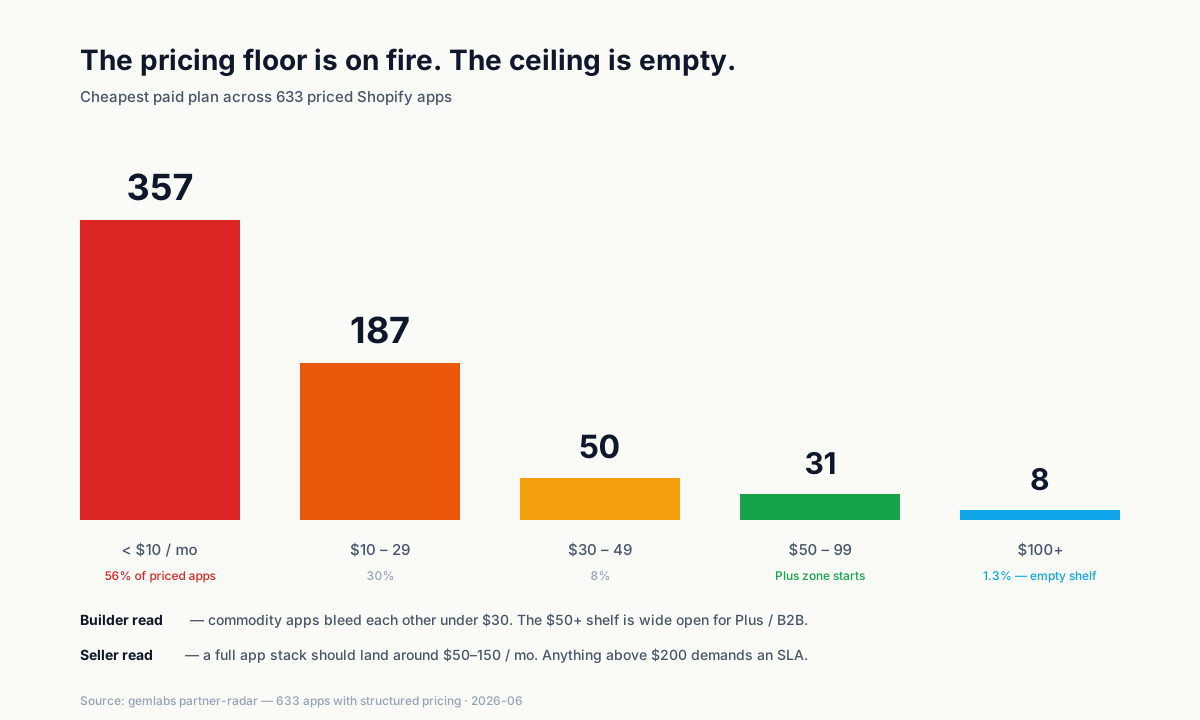
The floor is on fire. The ceiling is empty.
Eighty-six percent of priced apps start under $30/mo. Apps fight each other in a tiny strip of pricing that punishes everyone — you can’t fund a real product team off a $9 plan with sub-2% conversion from free. And yet there are only 8 apps in the entire catalog whose cheapest plan starts at $100 or more.
If you have ever sat across from a Shopify Plus merchant and watched them sign a $1,200/month contract with a SaaS vendor outside the App Store, you know what’s going on. The premium budget exists. It just doesn’t live in the App Store because almost nobody in the App Store is building for it. The 8 apps charging $100+ have far fewer reviews on average than the $10–29 cohort — not because the model doesn’t work, but because nobody is trying.
This is the single sharpest opportunity in the data: a real, premium, Plus-grade app priced above $99 that earns its keep on merchants doing seven and eight figures a year. The lane is open because everyone is busy fighting in the $9–29 mud pit.
The geography of the top of the catalog
If you look at the top 20 apps by review count, the developer-country pattern is striking. The order isn’t San Francisco and Tel Aviv — it’s Hong Kong, Vietnam, China, India.
A non-exhaustive sample from the top:
- Judge.me — Hong Kong — reviews
- PageFly — Vietnam — page builder
- GemPages — Vietnam — page builder
- Avada — Vietnam — SEO suite
- Globo — Vietnam — product options
- 17TRACK — China — order tracking
- Simprosys — India — Google Shopping feed
- Pop Convert — independent — popups
- Notify! — independent — back in stock
- STOQ / Artos — independent — preorder
The pattern holds across the wider crawl. Asia-built, globally served. The teams that figured out how to ship a focused product, support it in English at 2am Vietnam time, and price it competitively are the ones that ate the top of every commodity category.
For new builders considering geography: this is not a problem to overcome. It is the existence proof. The work happens in Hanoi, Saigon, Hangzhou, Bangalore, Hong Kong. The customer happens in Brooklyn and Berlin and Sydney. The wire works.
What about AI?
A lot of the noise this year is AI. We did a simple check on app names — how many apps in the catalog include “AI”, “GPT”, or “chatbot” in the name itself?
- 1,710 apps (about 8.2%) have “AI” in the name.
- 123 apps mention GPT or chatbot specifically.
Eight percent is large. It’s also smaller than the social-media impression that “every app is now an AI app.” And almost all of the AI labels are bolt-on — “AI-powered description writer,” “AI tagger,” “AI chatbot.” Useful, but not category-redefining.
The actual AI opportunity, in my read of the data, is not bolt-ons. It’s agentic apps that do the work end-to-end (agentic = AI-driven, completing multi-step work on its own without per-step human input) — apps that draft, ship, monitor, and revise without the merchant babysitting them. There are very few of those today. The catalog leaders are still “tools you operate.” The next decade’s catalog leaders will be “agents that operate the store.”
This is the most interesting greenfield the data suggests, and the partner-radar reviews velocity signal already shows it: a small cohort of agentic apps (post-purchase agents, ad-creative agents, support agents) is showing 30-day review growth far above category average. That’s the early shape of the next wave.
So — is there still room? Yes. Here is the honest shortlist.
I’m not going to dress this up. Most of the catalog is closed. Page builders, review apps, popups, generic upsell — those categories are won. If your pitch is “PageFly but cheaper” the data says don’t.
Here is what the same data says is still open, ranked by how cleanly the opportunity shows up.
1. Shopify Plus / B2B premium apps ($99+/mo). The empty ceiling. 47,000+ Plus merchants in the world, and the App Store offers them basically nothing priced for their problems. A premium B2B / wholesale / enterprise-grade app focused on Plus is the cleanest greenfield in the catalog.
2. Orders & Shipping and Inventory done well. Lowest average ratings in the table, real merchant pain. The incumbents are tolerated, not loved. A focused fulfillment-quality app that ships with great support and integrates the modern carrier APIs cleanly would take share quickly.
3. Vertical Customer Support / agentic post-purchase. Highest-rated category, smallest competitive pool, and the area where AI agents make the most economic sense (each ticket resolved automatically pays for the app twice over). Pick a vertical — beauty subscriptions, electronics returns, high-AOV apparel — and own it.
4. Localized apps for non-English markets. Most catalog leaders are built in Asia for English-speaking merchants. The inverse — apps built specifically for Japanese, German, French, Spanish merchants with native UX — is barely populated. Our country signal shows fewer than a dozen apps tagged with non-US/UK origin that also serve non-English merchants well.
5. Buy / rebuild a zombie. This one is unconventional. Twenty thousand zero-review apps include a long tail of apps where the developer abandoned a real, working integration. Some of these are acquirable for the price of a year’s hosting. If you want a faster start than zero, the zombies are an inventory.
What I would not start in 2026: a new page builder, a new review app, a new generic popup app, a new generic dropshipping app, a new “AI product description writer.” The data is brutal on each of these.
For the merchants reading this
If you sell on Shopify and you’ve installed five apps this month, here is what the same dataset means for you.
Use two safe-zone rings. The practical safe zone is 4.6★+ AND 100+ reviews — only 237 apps in the whole store qualify. The elite safe zone is 4.6★+ AND 1,000+ reviews — just 66 apps. Almost any problem you have already has a leader in the practical ring. There is no reason to install app #4,000 with a single review.
Watch the pricing floor. An app whose cheapest plan is $4/month cannot afford to support you well. It has to over-sell or be a side project. If the problem you are solving is important to your business, find a tool whose price reflects that — usually in the $20–80/mo range.
Audit your stack twice a year. Of the apps you have installed today, run them against the rating + recent-review-velocity check. If an app is below 4.5 and has not had a new review in 90 days, the developer has likely walked away. Replace it before it breaks during a Black Friday weekend.
Free tiers are fine, but read them like a contract. 220 of the 853 priced apps in our sample (26%) offer a meaningful free plan. Many of those are excellent for stores under $10k/mo GMV (gross merchandise value — the total dollar value of orders processed). The trap is the tier above — make sure the paid tier is priced like a tool, not a tollbooth.
Don’t outsource judgement to “Built for Shopify” badges alone. (That’s Shopify’s official quality programme — apps that pass a UX and performance review get the badge.) Useful, but not sufficient. Almost every commodity-category winner is independent, not first-party. Read the reviews, look at the responses from the developer, and watch how they handle complaints — that signal beats the badge.
Closing — what this catalog actually is
Twenty-one thousand apps is not twenty-one thousand competitors. It is a small, hot core of 500 real businesses serving the actual Shopify economy, surrounded by a vast cold outer shell of listings the platform never deletes.
The hot core is closed in some places and wide open in others. The closed places — page builders, review apps, generic popups — are closed because someone got there ten years ago and did the boring work for a decade. The open places — Plus, B2B, fulfillment-quality, agentic vertical support, non-English markets — are open because nobody has put in that decade of boring work yet.
That is the opportunity. It is real and it is narrower than the noise suggests.
The data behind this post comes from partner-radar — the catalog gets re-crawled weekly, reviews get snapshotted daily, and the long-tail enrichment keeps grinding through batches. If you build, this is the map. If you sell, this is your sanity check.
The App Store is not over. It is just much smaller and much sharper than the headline number suggests. Build accordingly.