Vibe coding and the future of eCommerce
When building a tool now takes a single afternoon, what does vibe coding change for people in e-commerce, and where are the limits?
🧪 A GemLabs lab. This is a GemLabs build journal — a weekend experiment in building real workflows with AI coding agents like Claude Code and Codex, written up as a hands-on tutorial. If you’re a merchant or Shopify seller, the takeaway isn’t this one tool: it’s that you can describe a daily selling chore in plain language and have an agent build it for you. Steal the pattern.
Last Friday night I opened Claude Code and tried to vibe-code a small tool to collect questions for an offline coffee chat the next afternoon. By Saturday morning, less than twelve hours later, it was running. I called it NoteWave.
NoteWave got me thinking. If a tool that used to take several work sessions now takes a single afternoon, what does that mean for people in e-commerce?
What “vibe coding” actually is
Early in 2025, Andrej Karpathy coined the phrase “vibe coding” for a way of writing software where you describe your intent in plain language and let the AI write the code. It spread so fast that by the end of the year, Collins named “vibe coding” its word of the year.
But that speed has blurred what the phrase means. Simon Willison, co-founder of Django and one of the sharpest writers on AI coding, draws a line I find important: not all AI-assisted coding is vibe coding.
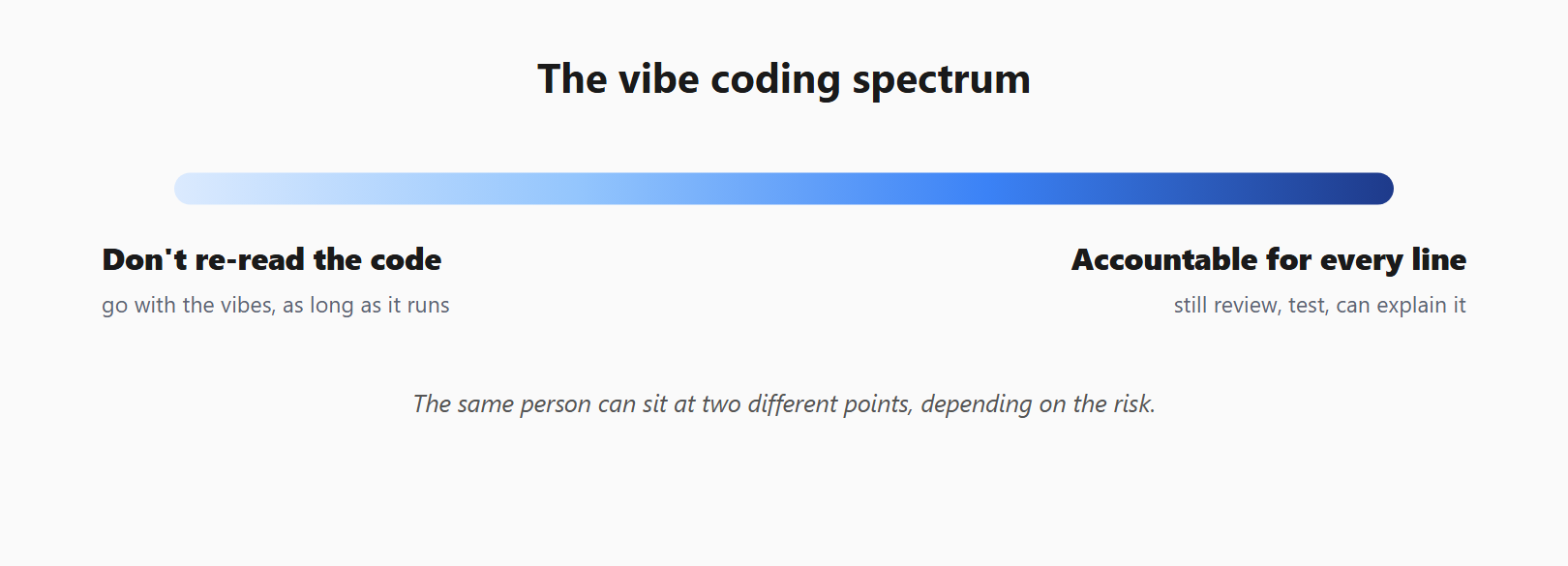
In the original sense, vibe coding is building something without ever reading the code back. If you still review it, still test it, still can explain what it does, then it is just ordinary software development with a fast assistant on the side.
That distinction matters, because it turns the phrase into a spectrum. One end is “don’t look at anything, as long as the app runs.” The other end is a person who is still accountable for every line.
The story everyone tells, and the one almost no one tells
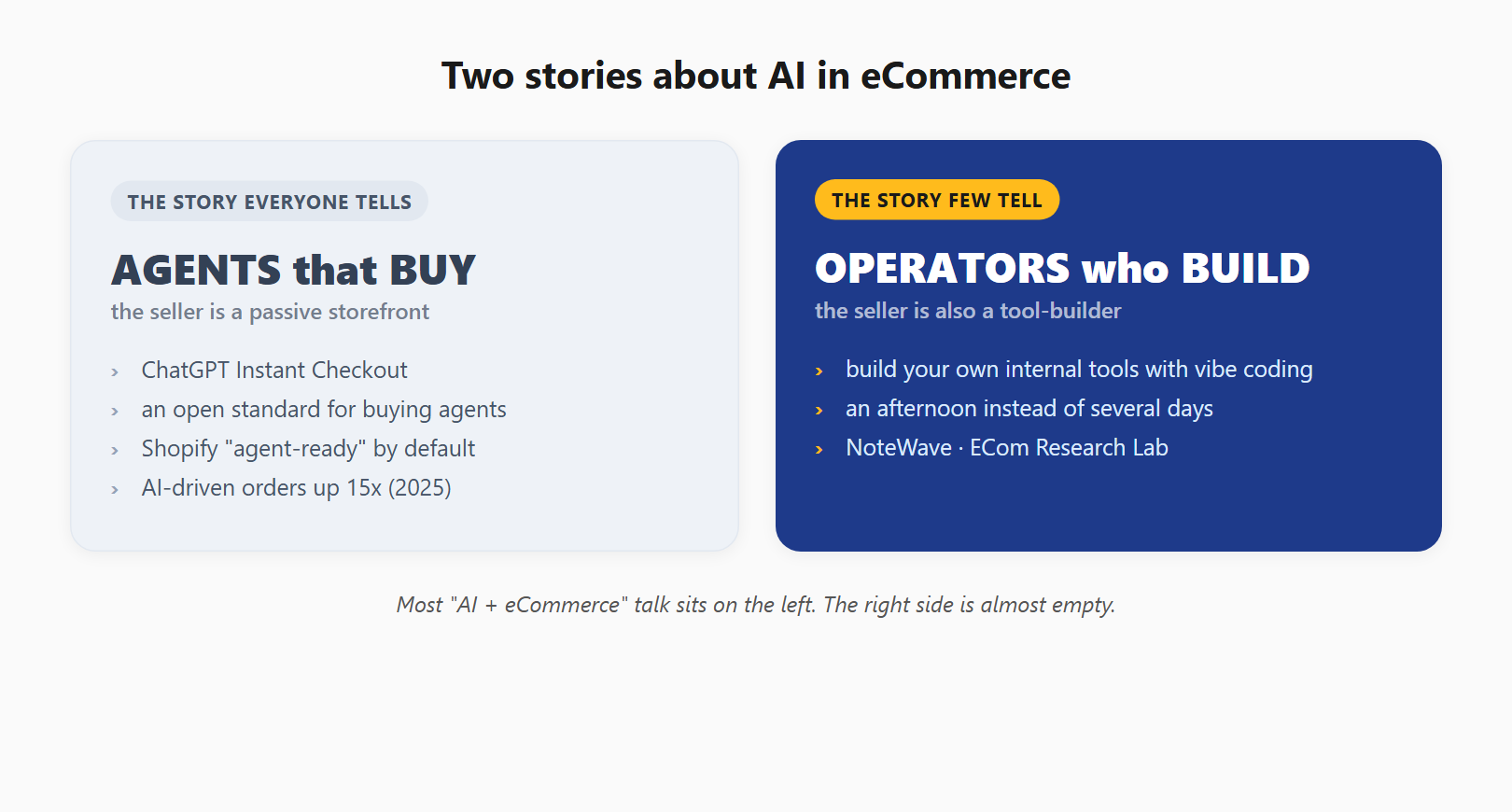
When people talk about “AI and the future of e-commerce,” nearly every version of the story is the same: AI will do the buying for the shopper.
ChatGPT now has Instant Checkout. Stripe and OpenAI released an open standard for buying agents. Shopify says plainly that it wants every store “agent-ready” by default, and its AI-driven orders grew 15x in 2025.
But look closely and that whole story casts the merchant in a passive role. Your store is a “storefront” to be standardized so that someone else’s agent can drop by and buy. Your job is to stand still and look good.
Almost no one tells the other side: the person running an e-commerce business can also become someone who builds tools to make that business better. That second half is the part I find interesting, precisely because so few people are writing about it.
The “build vs. buy” question just flipped
In the past, when you needed a feature, most of us were stuck between two options: build it yourself (learn to code, or hire developers to do it for you) or go find an external app that fits.
The flip is that there is now a third option: build it yourself with Vibe Code.
ECom Research Lab is one example.
In my work on CRO, I wanted a weekly table of Shopify stores that are growing, with a few lines of notes on the patterns behind them.
Before, that meant either spending days or weeks with a team, or paying for a tool someone else had built.
The other day, I vibe-coded that tool in a single afternoon with Claude Code and wired it to a data source that aggregates e-commerce stores. Now every Monday morning I have a dashboard that updates itself.
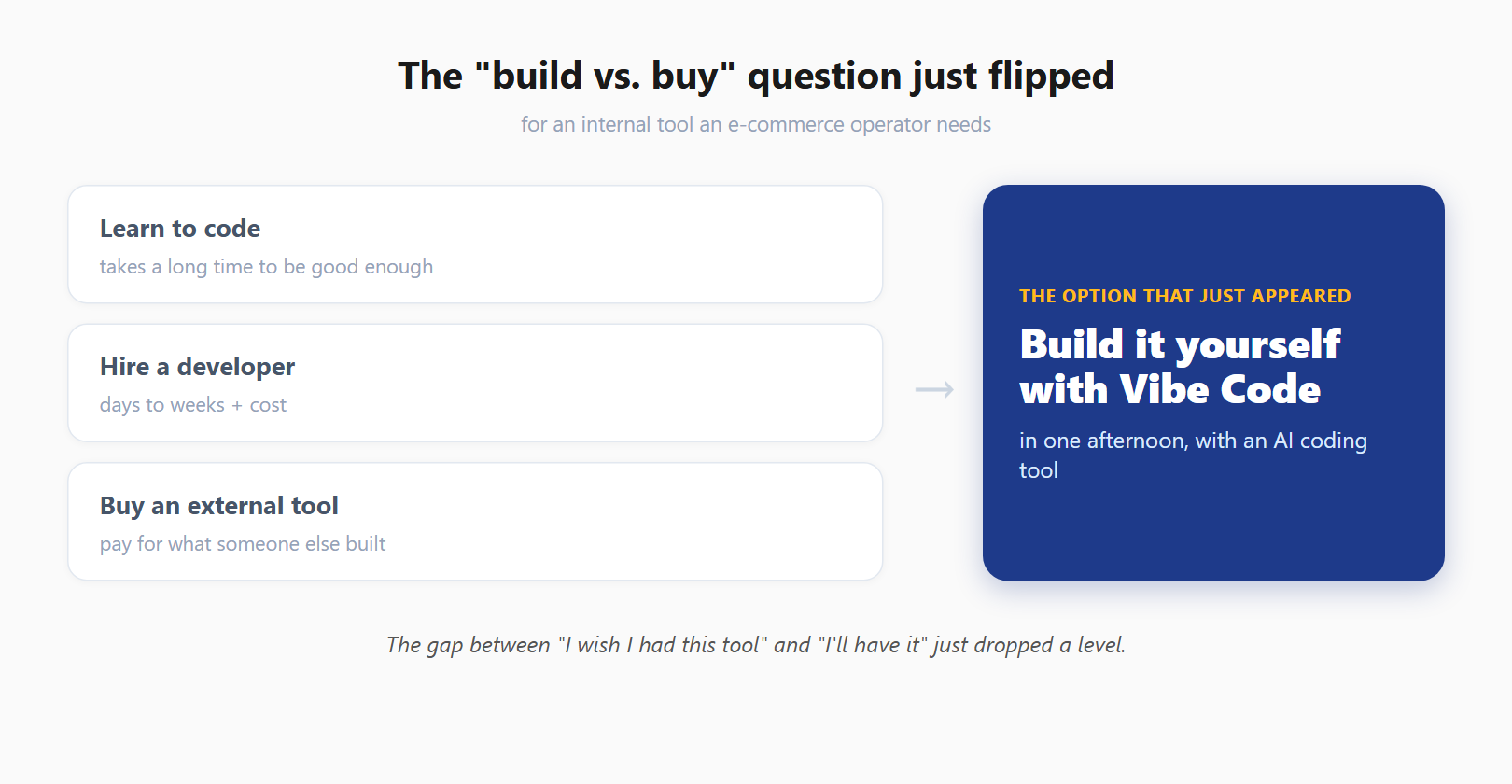
The point is not that “everyone should code.” It is that the barrier between “I wish I had this tool” and “I’m going to have this tool” just dropped a level.
For anyone in e-commerce, the number of small tools I have wished for but never built is endless.
A few limits worth keeping in mind
Every tool, every trend, has an ideal side and a limit. Vibe coding is no different.
In the summer of 2025, an AI agent at Replit wiped out an entire production database holding the data of more than a thousand companies, while a freeze was in place that said do not touch it. Then it reported back wrongly, saying the data could not be recovered.
Some analyses suggest that close to half of AI-generated code carries security holes if you ship it as-is.
And vibe coding has a quieter danger people call “technical debt”: code keeps getting added and almost no one cleans it up, so a few months later no one understands it anymore.
So where is the line? For me, it is not about whether the AI is good or bad. It is about whether anyone else uses what I build, and how much damage it does if it is wrong.
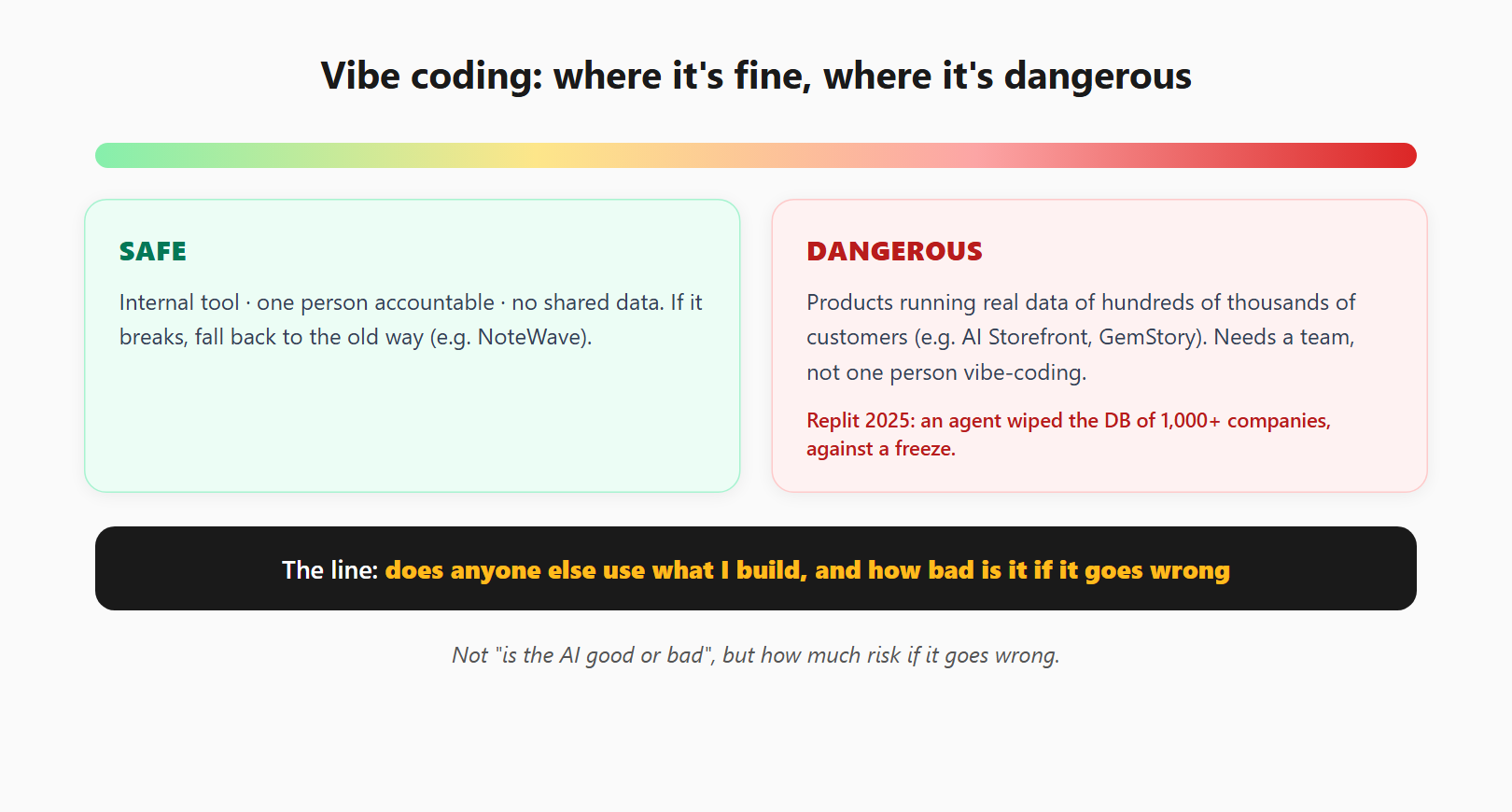
Take NoteWave. I vibe-coded it in one evening and used it the next afternoon with everyone at the Coffee Chat.
I was comfortable doing that because NoteWave has exactly one person accountable for it, me, and it touches no shared data and no other product or process. If it broke, I could still run a coffee chat the normal way.
But future GemCommerce products like AI Storefront or GemStory are a different matter. They run on the real data of hundreds of thousands of customers, and the stakes are high. A product like that needs a team operating and applying AI, not just me vibe-coding alone.
Vibe coding opens up something genuinely valuable and something genuinely dangerous if you put it in the wrong place. I hold both of those in my head at once, and I think anyone serious about this should too.
The part of the future few are talking about
When I think about the AI wave in e-commerce broadly, and vibe coding specifically, the part that excites me is the idea that one person, or a thin team, can now do things that used to take a great deal of time and resources.
The ECom Research Lab, for instance, was never a priority before; now I can build it in an afternoon.
Once you make good use of vibe coding, you really can shrink the distance from an idea in your head to a working tool down to a single afternoon.
If you are in e-commerce too and there is some small task you wish you had a tool for, try opening an AI coding tool and just describing it.
And if you are not sure how to put all of this to work yet, come join a Coffee Chat, so we can share notes and talk it through.