On Gem's core values
An organisation's core values aren't dreamed up by someone. They come from customers and the people who make the organisation. GemCommerce's story.
If you’d asked me five years ago, I’d have pulled up Amazon Leadership Principles, skimmed Zappos Core Values, and assembled a tidy localized version — polished, complete, and probably destined for a poster on the wall that nobody read after week two.
After years of building GemCommerce, here’s what I actually believe: core values aren’t something a founder dreams up in a workshop. They emerge — slowly, sometimes painfully — from years of friction with customers, circumstances, and your own blind spots.
Where do GemCommerce’s core values actually come from?
I found them in two places.
The first place is the customer.
Every business has a specific kind of customer with a specific kind of need. Apple’s customers want beautiful design and seamless products — Apple’s culture has no choice but to be obsessive about detail.
Founders don’t pick a culture and then go find customers. Customers pick the culture first. The founder’s only job is to read the signal correctly.
GemCommerce’s customers are Shopify merchants in 47 countries, mostly in health and beauty, doing anywhere from a few hundred thousand to a few tens of millions in annual revenue. They are not developers. They don’t have a tech team. They build their store alone or with a partner and one helper.
What do these people actually need from GemCommerce?
They need a tool powerful enough to compete with bigger brands, but simple enough they can run it themselves.
They need someone to answer a support ticket at 2 AM New York time — because that’s exactly when they’re still up, trying to optimize their store before tomorrow’s ad spend.
The moment I really looked at this group, I knew EMPATHETIC had to be a core value. Not because empathy is nice. Because our customers don’t survive without it.
The second place I found GemCommerce’s core values was in the founder — which is me.
In a company’s early years, the company is an amplification of its founder.
Founder obsesses over detail — team obsesses over detail.
Founder leads with data — team leads with data.
Founder says “ship and see” — team says “ship and see.”
The good news: founders don’t need to “build culture” in years one through three. Culture forms in the shape of whoever is in the room when decisions get made.
The bad news: if the founder has weak spots — hesitation, conflict avoidance, the inability to admit a mistake — the team inherits all of it, intact. You can’t teach your team something you don’t have yourself.
Ten years of writing GemPages taught me I have one strong thing and one weak thing.
Strong: I genuinely cannot accept “good enough.” I see the gap between what shipped and what could have shipped on everything, and I can’t unsee it. I’m constantly looking for the next improvement. That’s the root of EXCEPTIONAL.
Weak: sometimes I run on intuition. I have to admit it — plenty of my decisions over the years were made on feel. Most turned out fine. A few were badly wrong.
The lesson wasn’t “my intuition is bad, kill it.” The lesson was: I need a culture that counteracts my own weakness. That’s the root of EXPERT — a value written partly as discipline for me, not just for the team.
These two sources — customers and founder — intersect somewhere. That intersection is the actual culture of the organization.
“The Four E’s” — what makes a Gemian
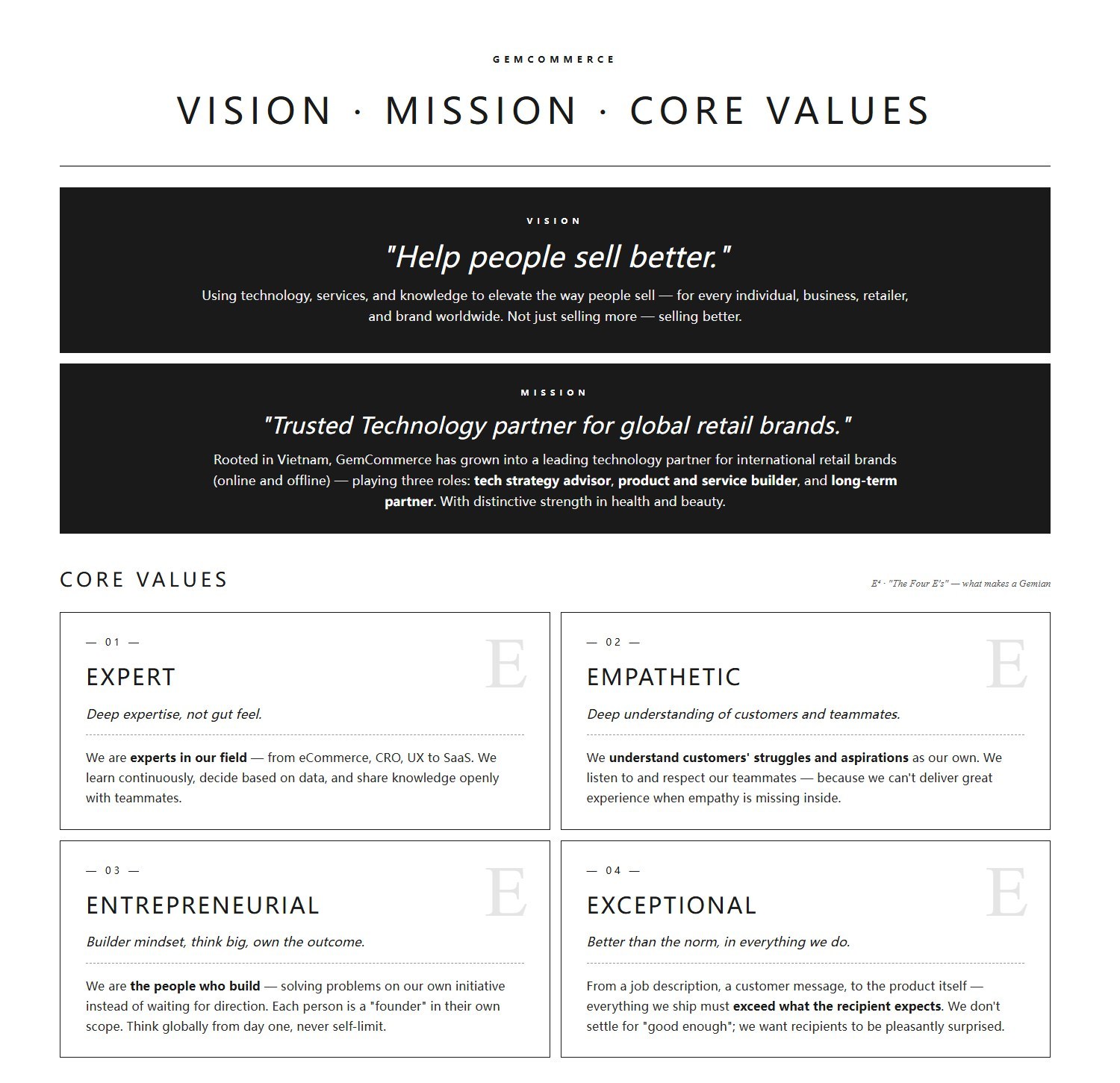
EXPERT — Deep expertise, not gut feel
As I said: this value is partly a rule I wrote for myself.
I lean on intuition. In Gem’s first five years, “ship and see” kept us alive — because when you have no resources, decision speed beats decision accuracy. Wrong is fine, as long as you fix it fast.
But once the team scaled and thousands of merchants depended on the product, an intuitive call no longer affected five people in a coworking space. It affected tens of thousands of people running their businesses on our platform.
So before any non-reversible decision, the first question stopped being “will this work” and became “what are we basing this on?” You either have data, or a precedent from a specific merchant, or a small experiment that ran first.
EXPERT doesn’t mean knowing a lot. It means knowing exactly what you’re standing on when you speak.
EMPATHETIC — Deep understanding of customers and teammates
For nearly two years, I slept at UPBK coworking — to save time, save money, and stay next to the product around the clock. Code late, sleep there, wake up, code again. UPBK let people stay overnight. For showers, I walked to the gym next door.
Through those two years, revenue was small. Not enough to cover salaries. The people I’d been counting on left, one after another. There were stretches where it was just me. There were months where I didn’t know if we’d make it.
Then one day, an email landed from a customer named Jie Kang, based in the US:
I’m flying to Vietnam. Want to meet Chris.
Jie Kang wasn’t an investor. He wasn’t a partner. He was a $29/month user of GemPages. Out of sheer affection for the product, he bought his own ticket, flew to Vietnam, just to meet me.
Jie Kang didn’t bring money. He didn’t bring a deal. What he brought was something else — and at that moment, I needed it more than I needed money.
Imagine being alone, deep in the part of your head where you’ve started doubting yourself, and a customer flies halfway around the world just to look you in the eye and say: what you’re doing matters.
That was one of the moments I learned customers aren’t just people who pay you — they can become real partners, if you treat them like real people.

Tony Hsieh, Zappos’s founder, said something I’ve come back to many times: customer service shouldn’t be a department, it should be the whole company. The line is familiar enough to be a cliché. But the way Zappos actually practiced it — no call center scripts, agents allowed to stay on a call as long as needed, an 8-hour call retold as an achievement — showed they had genuinely built the company around that idea. Not a poster.
That’s the gap between a value and a slogan.
Same with EMPATHETIC at GemCommerce. It doesn’t mean being nice. It means a hard requirement: every product, support, and marketing decision has to pass through the question — “what is the merchant on the other side of this screen actually dealing with, and how do we help?”
ENTREPRENEURIAL — Builder mindset, think big, own the outcome
I’m a builder. That’s the title that’s defined the last ten years for me.
When I hire, I hire for the same trait. Not because I’m trying to clone myself — but because I know non-builders won’t survive the environment we run. They’ll wait for me to assign work. They’ll ask permission before each small decision. Both ways, they burn out in a few months.
In 2018, I hired GemCommerce’s first interns: Antony and Nicolas from PTIT, Janie from FTU. They weren’t experienced developers. They weren’t stars. They were third- and fourth-year students — but they had one thing I needed: they took initiative.
I hire for drive and mindset first. Skill can be learned in six months. Mindset can’t be taught in three years.
EXCEPTIONAL — There is no “best,” only “better”
EXCEPTIONAL isn’t perfectionism. It’s a habit, and a question asked before anything goes out the door: can this be better?
The problem isn’t with “good enough” itself, because “good enough” is a subjective feeling. The problem is compared to what.
When our merchants open GemPages, they aren’t comparing us to another Vietnamese app builder. They’re comparing us to the products they use every day: Notion, Linear, Stripe, Klaviyo. That’s the real bar. The bar sits much higher than “good enough by the standards of a Vietnamese startup.”
The same logic applies to everything we ship outward. A new feature isn’t being compared to last month’s Gem; it’s being weighed against the best version on the market at the moment it ships.
The real bar our customers hold us to is set by the best players in their landscape, not by us.
So what is EXCEPTIONAL in practice? Before I ship anything, I pick a reference one notch above myself last week. Then I spend time on the final pass, the part that decides whether the recipient remembers. And I stay sharp enough to know when to stop polishing, and when stopping isn’t an option yet.
The price is speed. Every output at this bar costs more time, more review, more iteration. I take that, because work built to this standard doesn’t disappear after a quarter. It compounds into the one thing that’s hard to copy: a team’s internal standard.
This isn’t theory. Every year I open up what the team shipped 12 months ago. Most of it looks lower than today’s standard. That’s how the standard quietly rises.
Why We Exist — GemCommerce carries a vision that isn’t only mine
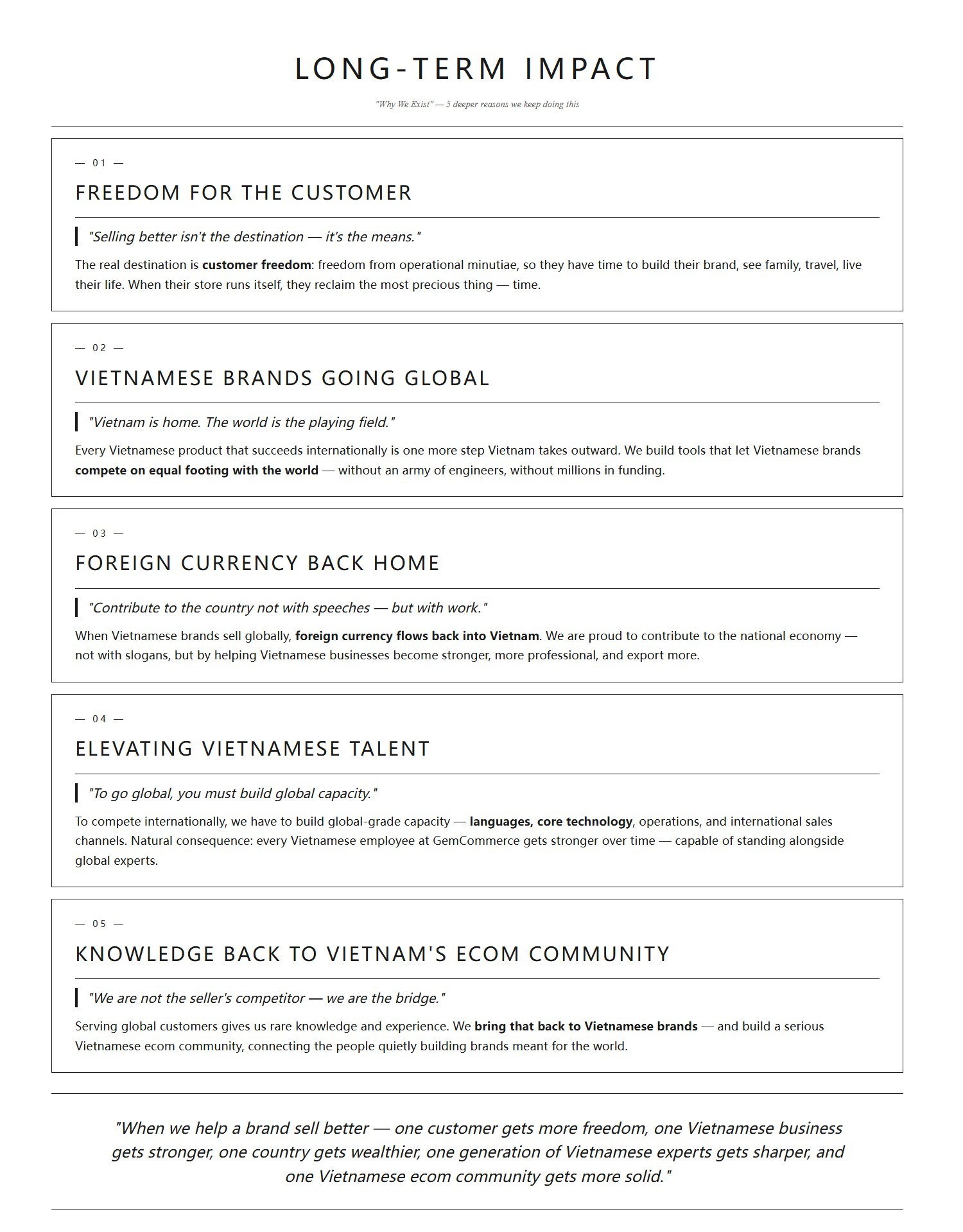
Freedom for the customer
A merchant I met at an event in Singapore told me: before GemPages, he spent a few hours each week manually testing landing pages. After automating it, those hours went to driving his kid to football practice.
For me, that is the real output of “help people sell better” — not revenue. Three or four reclaimed hours.
Vietnamese brands going global
Every Vietnamese product that succeeds internationally is one more step the country takes outward.
When I look at Taiwan’s semiconductor industry, TSMC isn’t strong because Taiwanese engineers love their country more than anyone else.
TSMC is strong because a generation of operators bet thirty years on one extraordinarily hard industry — and they won.
I want Vietnam’s ecommerce sector to be telling a similar story ten or twenty years from now.
Foreign currency back home, Vietnamese talent on the global stage
You contribute to a country not with speeches, but with work.
When Vietnamese brands sell globally, foreign currency flows back into Vietnam. When GemCommerce serves merchants in the US and EU, our engineers in Hanoi get paid in USD.
And precisely because of that — to compete internationally, we have to build global capacity. Languages, core technology, the way we operate, international sales channels.
A natural consequence: every Vietnamese engineer at Gem, supporting customers across 47 countries 24/7, ends up with a skill set most of their peers in Vietnam don’t have access to. Not because they’re smarter. Because they were placed in a higher-standard environment.
Five years from now, whether they’re still at Gem or not, they’ll be a generation of Vietnamese engineers different from the one before them. That’s a long-term bet on people, not just on GemCommerce.
Bringing knowledge back to Vietnam’s ecom community
After ten years serving global merchants, we’ve accumulated a stack of knowledge that Vietnam’s ecom community doesn’t have easy access to: US market psychology, Korean brand retention patterns, UK agency A/B test frameworks.
We bring that back to Vietnamese brands — and we’re building a serious Vietnamese ecom community alongside it, connecting the people quietly building brands meant for the world.
When we help a brand sell better — one customer gets more freedom, one Vietnamese business gets stronger, one country gets wealthier, one generation of Vietnamese experts gets sharper, and one Vietnamese ecom community gets more solid.
Culture evolves
One last thing: the words you’re reading today will probably change.
I won’t stubbornly hold on to today’s wording if the conditions change. Culture has to live with the company, not the other way around. But one thing won’t move — the mission of GemCommerce, and of every Gemian:
Help people sell better.
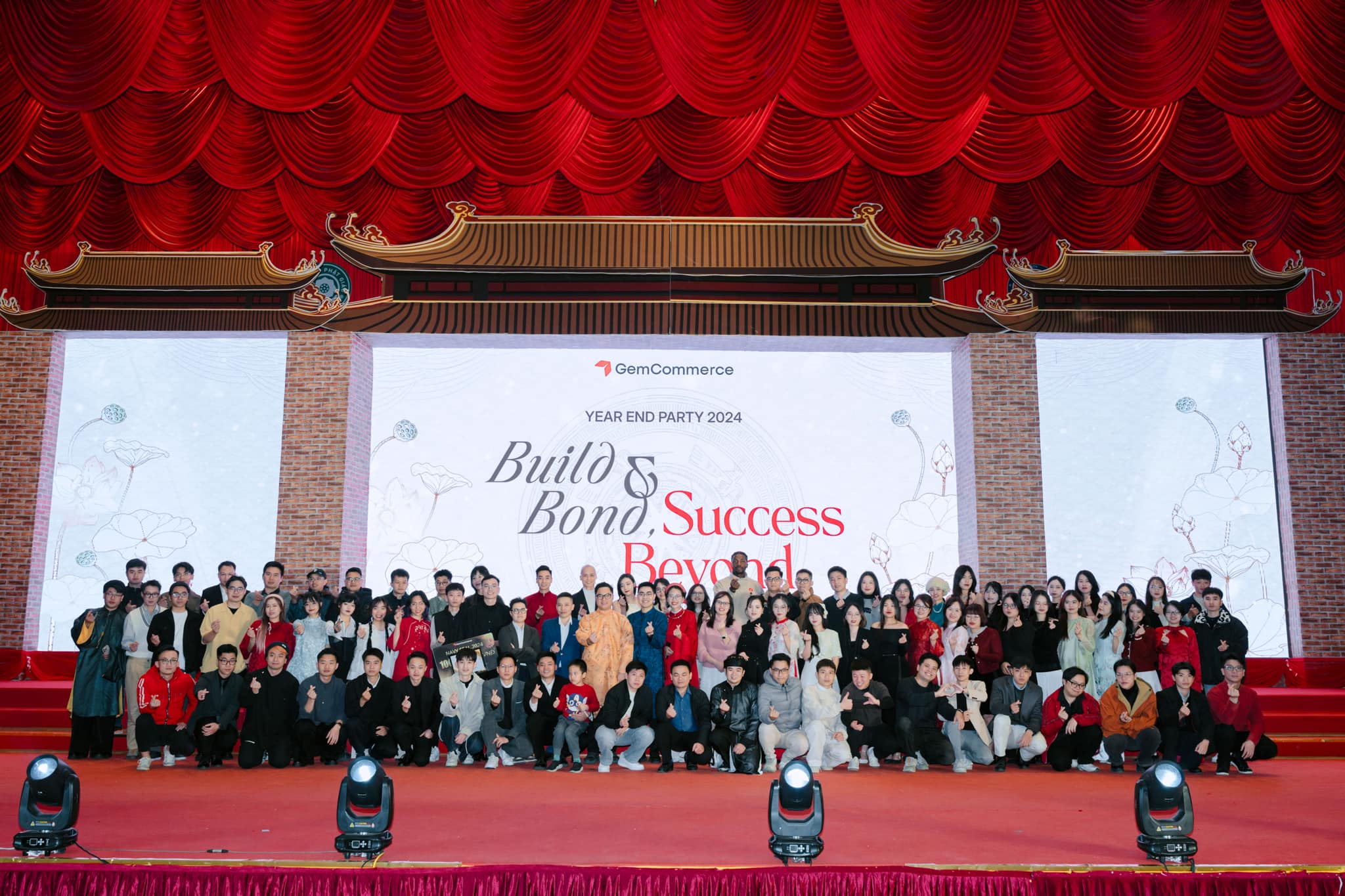
GemCommerce, in moments
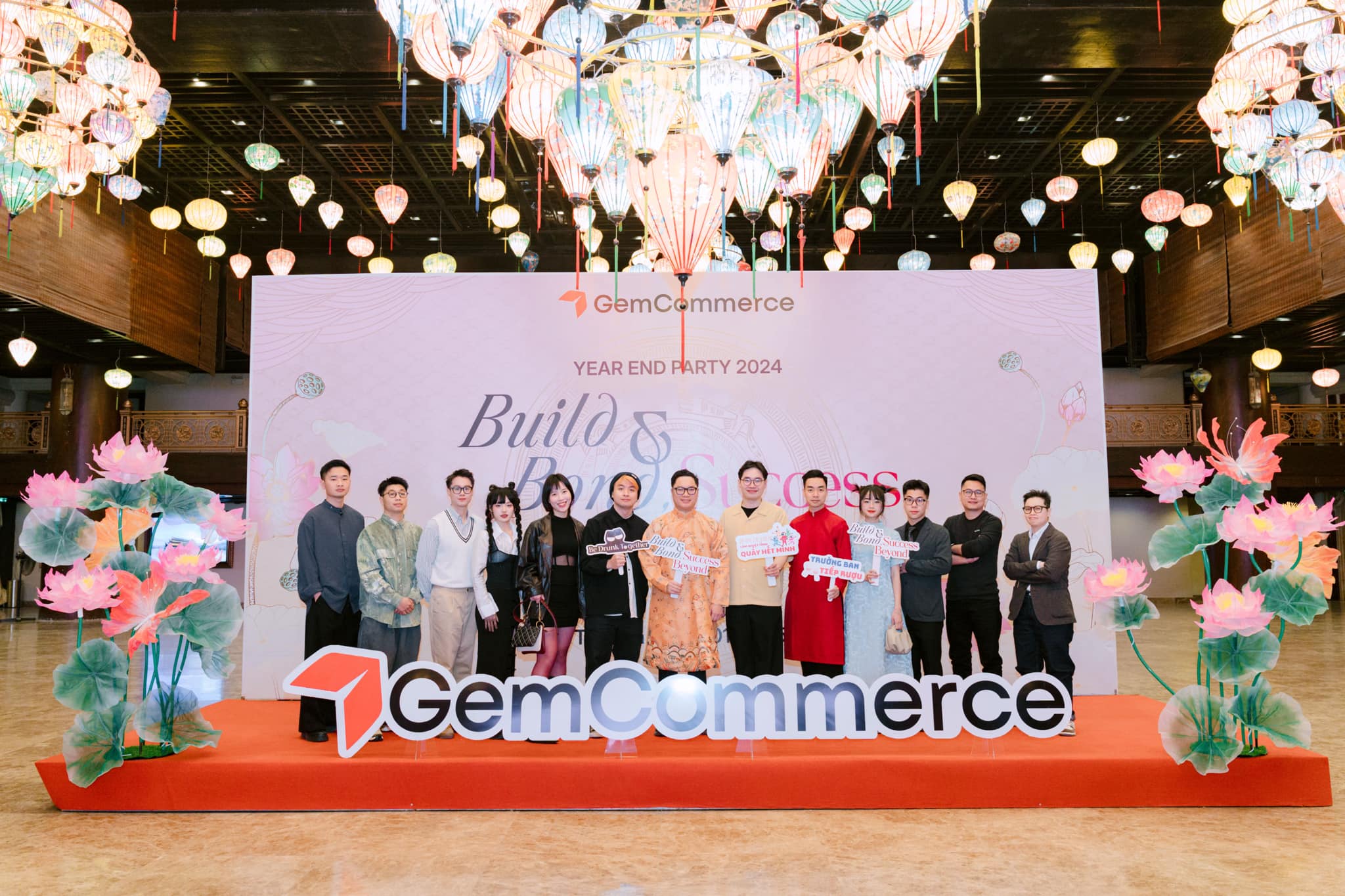
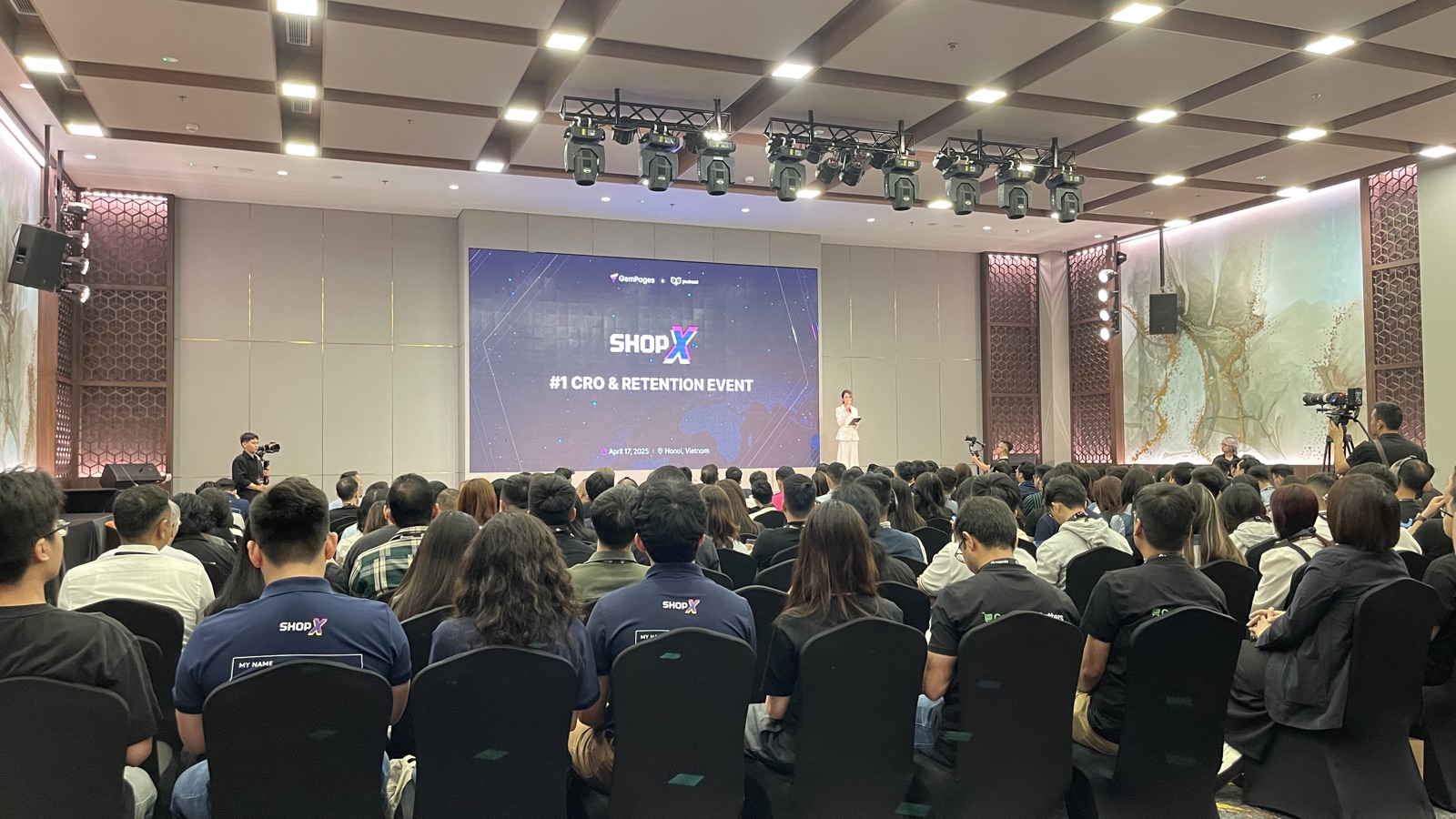
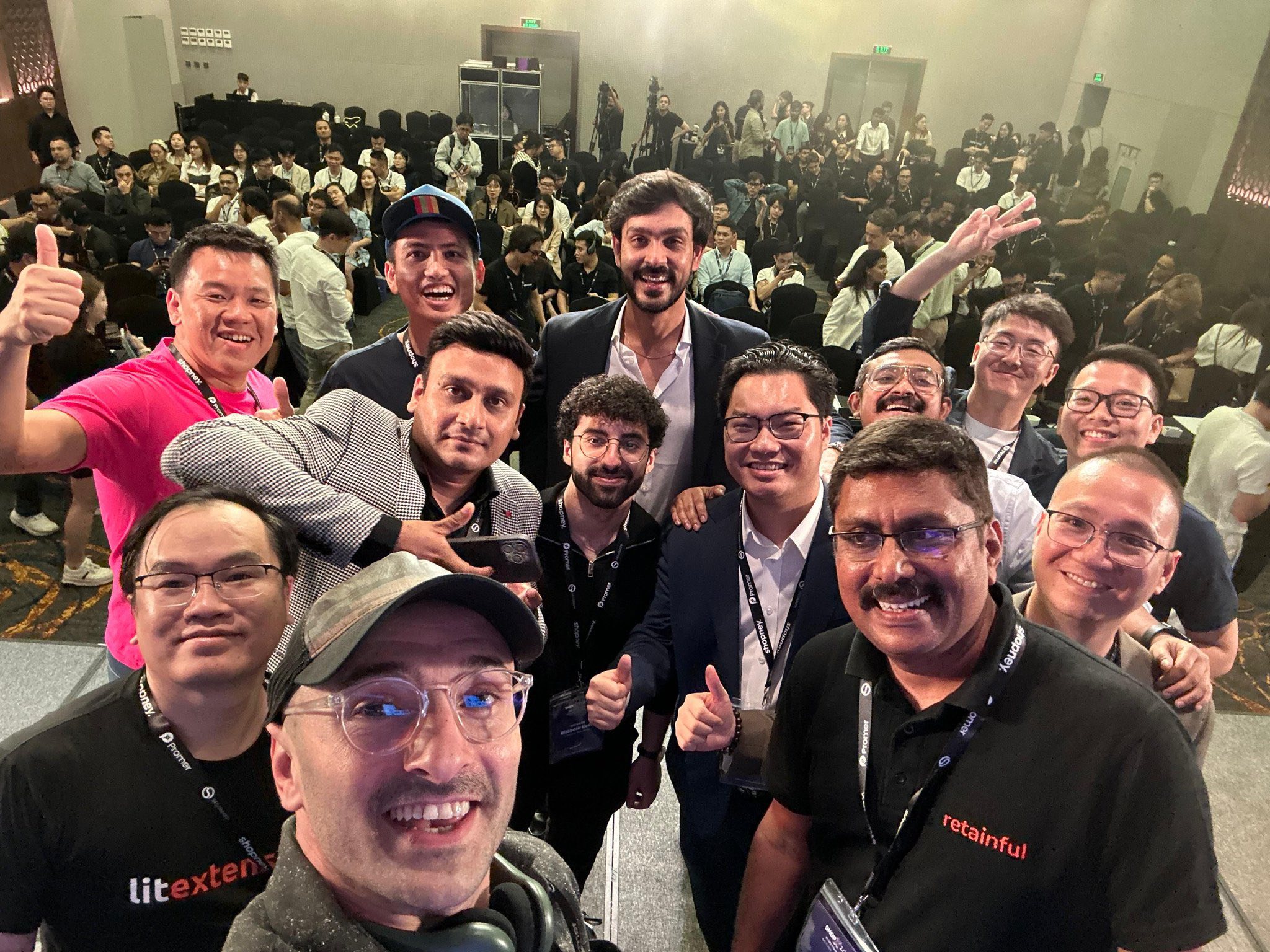
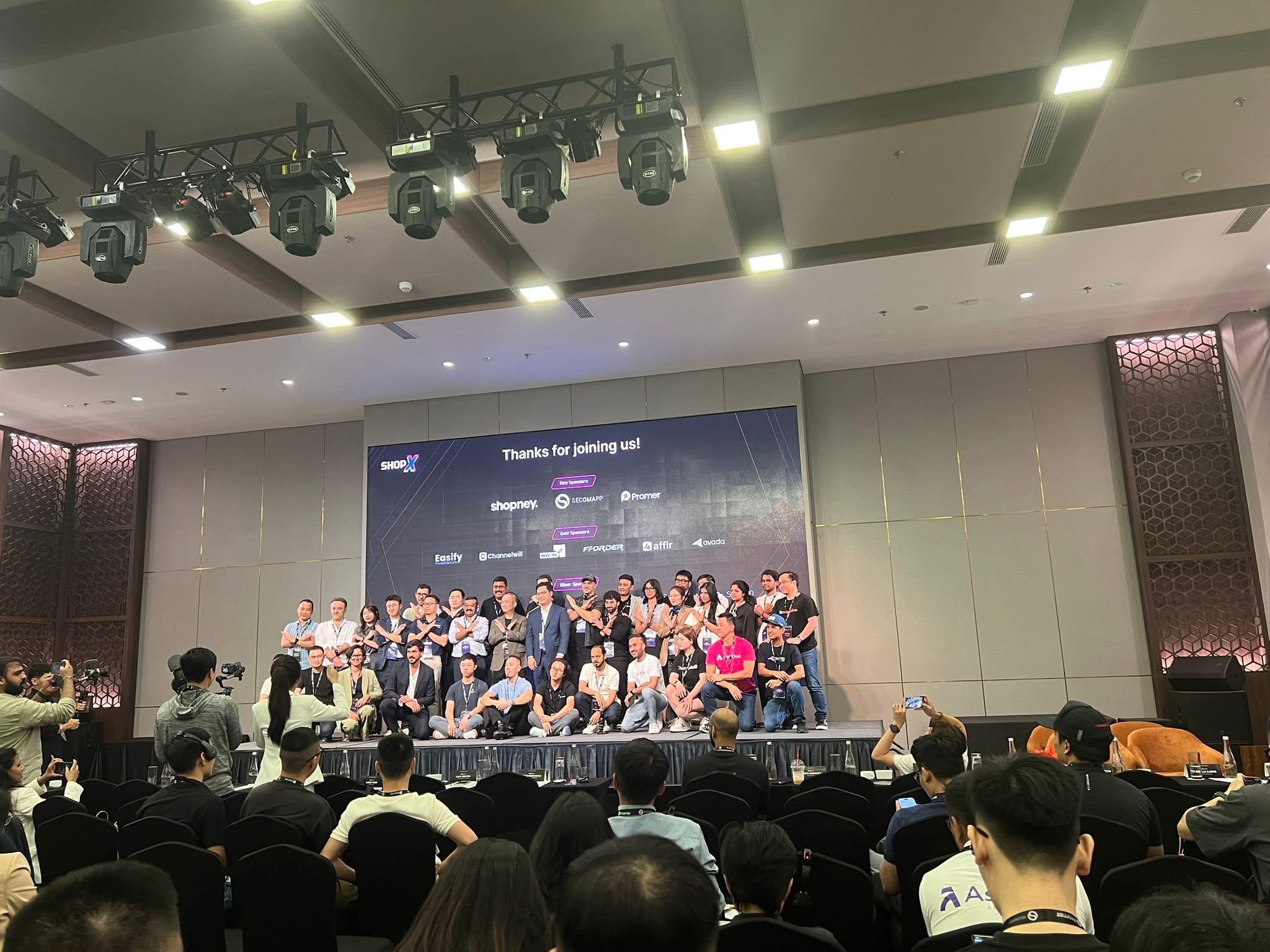
A few frames from the GemCommerce road — the stage, the team, the community that walked it with us.